
I Dream
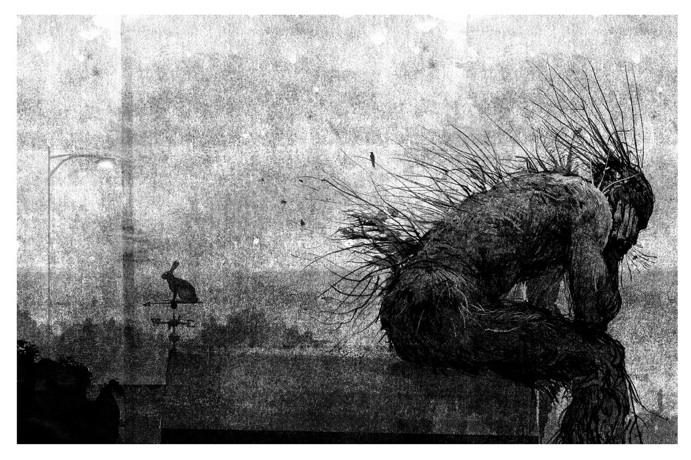 Review the image to the right from A Monster Calls by Patrick Ness, illustrations by Jim Kay. The fantasy novel details the tribulations of a 13 year old boy (Connor) that has nightmares when an ancient yew tree visits and shares stories with Connor. The image to the right shares a moment while the yew tree, portrayed as a monster waits for Connor to come out and fin
Learning Event Response -
Review the image to the right from A Monster Calls by Patrick Ness, illustrations by Jim Kay. The fantasy novel details the tribulations of a 13 year old boy (Connor) that has nightmares when an ancient yew tree visits and shares stories with Connor. The image to the right shares a moment while the yew tree, portrayed as a monster waits for Connor to come out and fin
d him.
After you review the image, watch the video American Shokunin by Ryan Bush. The video details the work, art, and philosophy of Ryan Neil.
Consider the imagery in the illustration and the video. What common threads are present between the two texts? What beliefs do the authors of these texts share about our dreams and possibly our nightmares? What do the authors believe is the purpose of our dreams? What can we possibly do with our dreams if given the opportunity? What becomes of a dream deferred and allowed to dry up? Are you allowed to follow your dreams...or are they dictated by another?
Play, create, and share an image or video of a dream that you have had and provide a subtext for that dream. You might choose to capture a photo or video. You might choose to paint or illustrate an image using an online or offline tool. You could use iPiccy which is a great simple online photo editing tool or Thinglink which is another image tool that allows links etc to be embedded into your image. You might even choose to add an audio soundscape to your work.
My Response -
When thinking about dreams and imagery, I couldn't help but think about the surrealist work of Salvador Dali. Somewhere between reality and a dream state, his work always seem illogical to me. His painting style was clean with crisp lines, unlike the Impressionists, but the topics were imaginative. Like the painter himself, the art feel eccentric.
Dreams fall into the same category for me. They are eccentric and deviate from my "typical." Just as Jim Kay's illustration of A Monster Calls, there is a sense of normality but something is a kilter. Upon closer inspection, the yew tree monster doesn't feel scary or intimidating but sad, very unmonster-like. But as Ryan Bush says in the video American Shokunin "the scars that look very artificial when first created begin to look very natural as they weather and age." Our dreams may feel artificial but there is something very real about who we see when we close our eyes and allow our imagination space to cultivate.
The faces in our dreams are those of someone we have encountered in our lives. Our imagination does not invent a new visage, but uses ones already logged in our memory. But, I can never remember the exact face I dream of or who it belongs to. I usually remember what happened in the dream, but can never quite place who was involved. This doesn't matter in the long run because I believe every dream leads you to a better version of yourself, wither by pointing out flaws you won't admit to during the day or illuminating a path maybe unconsidered.
Below is a VoiceThread I created summarizing my recent dreams. The clay faces are made by students at my school and are displayed in an outdoor courtyard. I often find myself wondering about the student that created each face.

No comments:
Post a Comment